
• Home
  • About
    • What We Do
    • THR In the News
    • Our Founder & Publisher
    • Our History
    • Founding Sponsors
    • Community Partners
    • Advisors
  • Top of Day
  • News
    • Arizona News
    • National News
  • Member Resources
    • Comings & Goings
    • 2022 State of the State Post-Conference Resources
    • Industry Links
    • White Papers, E books, Reports and more
    • Toolbox
  • Professional Directory
    • THR Business Directory
    • Member Directory
    • Founding Sponsors
    • Community Partners
    • Advisors
    • Corporate Profile Intake Form
    • Corporate Profile Change Request
  • Newsletter/Data
    • The Hertel Report October 2025 Newsletter
    • Data Resources
    • Newsletter Archive
  • Events/Products
  • Register
  • Log in
The Hertel Report
  • Contact Us
  • Events
  • Become a Member
  • My Membership
  • My Profile
The Hertel Report
  • Home
  • About
    • What We Do
    • THR In the News
    • Our Founder & Publisher
    • Our History
    • Founding Sponsors
    • Community Partners
    • Advisors
  • Top of Day
  • News
    • Arizona News
    • National News
  • Member Resources
    • Comings & Goings
    • 2022 State of the State Post-Conference Resources
    • Industry Links
    • White Papers, E books, Reports and more
    • Toolbox
  • Professional Directory
    • THR Business Directory
    • Member Directory
    • Founding Sponsors
    • Community Partners
    • Advisors
    • Corporate Profile Intake Form
    • Corporate Profile Change Request
  • Newsletter/Data
    • The Hertel Report October 2025 Newsletter
    • Data Resources
    • Newsletter Archive
  • Events/Products
Home
CMS Rules

CMS Extends Bundle Payments for Care Improvement Advanced Model for 2 Years

October 25th, 2022 Lauren De Young CMS Rules, News, Top of The Day

The Centers for Medicare and Medicaid Services (CMS) announced the extension of the BPCI program to December 2025 along with the agency’s plans to release a 2023 RFA for Medicare ACOs interested in applying for the model, which was expected to end next year.

In 2018, the Bundled Payments for Care Improvement Advanced (BPCI Advanced) Model launched tying payments together for a single episode of care, incentivizing improvement of care and promoting care coordination among providers, which can include physicians, hospitals, and other care providers. The model tests if linking expenditures can reduce Medicare costs while simultaneously maintaining or improving quality of care.

In the announcement, CMS detailed changes to the program in 2023, including:

  • Reducing CMS discount for medical clinical episodes from 3% to 2%
  • Reducing the Peer Group Trend (PGT) factor adjustment cap for all clinical episodes from 10% to 5%
  • Holding participants accountable for all clinical episodes in which the beneficiary has a COVID-19 diagnosis during the clinical episode
    Note: In 2020, following the pandemic outbreak, BPCI had the options to exclude beneficiaries with a COVID-19 diagnosis from model reconciliation.

The BPCI model works by holding participant organizations or individuals financially accountable for beneficiaries’ clinical episodes, which end 90 days after a procedure or discharge. As explained in Revcycle Intelligence, “Episode payments are then compared to the episode initiator’s risk-adjusted target price. Participants receive a reconciliation payment if the episode payment is below the target price. But if episode payments are above the target price, providers must repay Medicare a portion of the financial losses.”

reconciliation graphic

The program has seen some success with the Third Evaluation Report, which covered Years 1 and 2 from October 2018 through December 2019, finding:

  • The model resulted in a 0.4% net loss for Medicare, although the model was designed for 3% net savings. 
  • Medicare did successfully save 3.6% for surgical clinical episodes, but these savings were offset by medical episodes, which produced a net loss of 2.2%. 
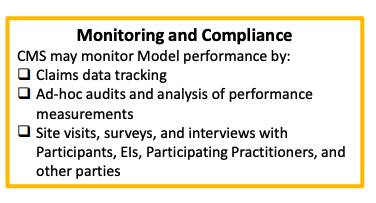
monitoring and compliance in the BPCI Advanced Model

Services covered by BPCI Advanced include:

  • Inpatient or outpatient hospital services that comprise the Anchor Stay or Anchor Procedure (respectively)
  • Clinical laboratory services, durable medical equipment
  • Inpatient hospital readmission services; Other hospital outpatient services
  • Physicians’ services
 
  • Part B drugs 
  • Skilled nursing facility services
  • Inpatient rehabilitation facility services
  • Long-term care hospital services
  • Home health agency services
  • Hospice services
  • The request for application for the two-year extension will be sent in early 2023 to Medicare enrolled providers and suppliers and Medicare Accountable Care Organizations. As of December 2021, BPCI Advanced participants include over 1,800 acute care hospitals and 69,867 physicians with over 1.2 million beneficiaries receiving care from participants, according to the CMS announcement. 

    • Tags
    • BPCI Advanced
    • BPCI Advanced Model
    • CMS extension
    Facebook Twitter Google+ LinkedIn Pinterest
    Next article Report: Healthcare Industry Lost 334,000 Healthcare Providers in 2021
    Previous article Arizona Abortion Updates

    Lauren De Young

    ASU student studying journalism and mass communication

    Related Posts

    The Hertel Report Winter State of the State Conference News

    The Hertel Report Winter State of the State Conference

    Kennedy's HHS Unilaterally Alters Recommended Childhood Vaccine Schedule National News

    Kennedy's HHS Unilaterally Alters Recommended Childhood Vaccine Schedule

    ACA Enrollment Down Nationally Following Expiration of Enhanced Premium Subsidies Arizona News

    ACA Enrollment Down Nationally Following Expiration of Enhanced Premium Subsidies

    Leave a Reply Cancel reply

    You must be logged in to post a comment.

    • Home
    • About
    • Top of Day
    • News
    • Member Resources
    • Professional Directory
    • Newsletter/Data
    • Events/Products
    • Back to top
    © The Hertel Report 2017. All rights reserved. | Privacy Policy