

The Centers for Medicare & Medicaid Services (CMS) provided a new roadmap for deciding which Medicaid beneficiaries are too medically impaired to meet 2027 work requirements. However, they leave much of the clinical and administrative decision-making to states.
Issued Sept. 8, CMS’ guidance outlines an optional three-tiered approach for determining whether an enrollee qualifies for the medical-frailty exemption as states race to implement Medicaid work requirements by January 1, 2027. The requirements, created under the Trump Administration’s signature tax law, generally require certain Medicaid enrollees to complete 80 hours a month of work, school, job training or community service. The law exempts people who meet specific criteria, including those considered medically frail. The statute identifies five categories that can qualify someone as medically frail: a physical disability, substance use disorder, disabling mental health condition, an impairment that limits activities of daily living, or a serious or complex medical condition.
CMS’ interim final rule established a two-part test. An enrollee must meet one of the statutory categories and show that the condition significantly impairs the person’s ability to meet the community-engagement requirement. The new guidance provides more detail on how states can make that determination.
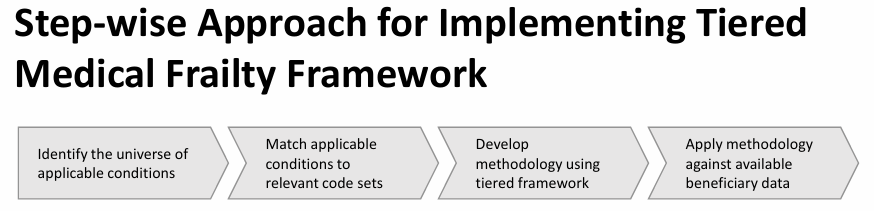
- Tier 1: covers conditions for which readily available diagnosis codes can establish significant impairment, such as ALS, end-stage renal disease or certain cancers.
- Tier 2: includes conditions that may indicate medical frailty but require additional information, such as utilization data, medications, durable medical equipment or functional assessments.
- Tier 3: requires an individualized manual review when available data are insufficient.
 CMS recommends that states use multiple data sources such as:
- ICD-10 codes
- Fee-for-service and managed-care claims
- Encounter data
- Short-term disability claims
“Because an exclusion on the basis of medical frailty depends on whether a health condition or conditions significantly impairs an individual’s ability to comply with the community engagement requirement, determining whether an individual qualifies for the exclusion may require consulting multiple data sources,” CMS said in its guidance. The agency’s approach could reduce the need for manual reviews, but it also puts states in the position of developing their own methodologies and code lists.
Modern Healthcare reported Kinda Serafi, a partner at Manatt Health said, “Without granular guidance from CMS, they’re going to be asked to make thousands of clinical and policy judgments, and there’s a real possibility that those decisions are going to be scrutinized years later.”
Providers face their own concerns. Susan Dentzer, president and CEO of America’s Physician Groups, said the tiered system may not reflect the complexity of patients’ conditions and could force clinicians to document whether patients qualify for an exemption. “This violates every principle of medical ethics known to humankind,” Dentzer said. “It’s going to put clinicians in the position of sitting as judge and jury over whether their patients not only can work or not but, frankly, whether they can still be on Medicaid.”
Technology vendors and Medicaid managed-care organizations also could play a significant role because insurers already hold extensive claims and clinical data. But, as Emma Liebman of the Alliance of Community Health Plans noted, effective data-sharing will require planning that many states have yet to complete. The debate continues as Inside Health Policy stated The American Public Health Association along with dozens of other stakeholders, including Arizona, recently filed an amicus brief in the case, urging the courts to grant states’ request for summary judgement ahead of the next hearing on Oct. 20.
The guidance gives states a framework, but significant questions remain about how medical frailty determinations will work in practice as the Jan. 1 deadline approaches.
Leave a Reply
You must be logged in to post a comment.